
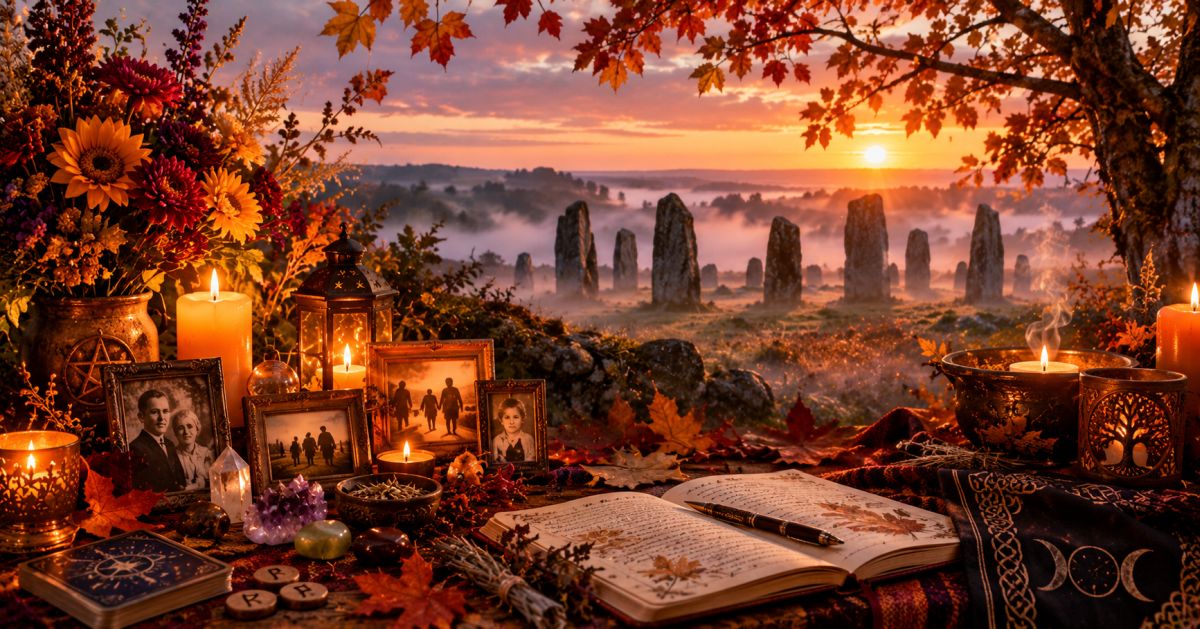
The Wheel of the Year · Celtic Wisdom · Ancestral Remembrance
Samhain: Honouring the Ancestors, Embracing the Darkness and Listening to the Wisdom of the Soul
As the leaves fall, the earth grows quiet and the veil of autumn mist settles upon the land, we arrive at one of the most sacred and contemplative times of the Celtic year. Samhain invites us to pause, honour those who came before us, release what has reached its natural ending, and discover the magic waiting within the darkness.
There is something profoundly beautiful about this time of year. The golden leaves drift gently to the ground, the trees reveal their intricate branches, and the familiar landscape takes on a different kind of beauty. The days grow shorter, the evenings draw us indoors, and nature begins her gradual descent into winter’s embrace.
For those who follow a Druidic, or Celtic-inspired spiritual path, this is a time to listen more deeply. The earth is teaching us that endings are not failures, that rest is not inactivity, and that even in the darkest season, life continues to gather its strength beneath the surface.
Samhain is an invitation to honour this wisdom, to remember our ancestors with gratitude, and to turn inward with an open heart.
Whether you celebrate through Druidry, Pagan spirituality, ancestral traditions, or simply a love of the natural world, may this season bring you a deeper connection with the land, your own inner wisdom, and the sacred rhythms of life.
What is Samhain? Understanding the ancient festival
Samhain, commonly pronounced SOW-in is an ancient Gaelic seasonal festival traditionally associated with the transition from the lighter half of the year into the darker half. It is observed on 31 October with celebrations and seasonal observances. It is regarded as one of the eight festivals of the Wheel of the Year and is seen as the beginning of the spiritual New Year.
Samhain marks the end of the harvest season and the beginning of winter, a time when we prepare for colder weather, gather together, and recognise the uncertainties and possibilities of the season ahead. It is also a well known time of supernatural encounters, extraordinary happenings, and crossings between the human and Otherworldly realms.
Samhain is associated with honouring the dead, remembering loved ones, divination, reflection, and the symbolic thinning of the veil between worlds. These spiritual interpretations have evolved through different traditions over time, but the central themes of transition, remembrance and the mysteries of life and death remain deeply meaningful.
Samhain is an opportunity to deepen our relationship with the land, acknowledge the cycles of nature, honour the ancestors, and recognise that we, too, belong to something much older and greater than ourselves. It reminds us that we are not separate from the natural world. We are part of its cycles, shaped by its seasons, and connected through countless generations of life.
The spiritual meaning of Samhain: A time between the worlds
At the heart of Samhain lies the understanding that life moves in cycles. We experience beginnings and endings, growth and decline, joy and sorrow. We welcome new chapters and eventually learn to release those that have fulfilled their purpose.
Yet endings can be difficult. We may cling to familiar circumstances long after they have stopped nourishing us, hold on to old hurts, or feel reluctant to step into the unknown. Samhain offers us a different perspective. Look at the trees. They do not apologise for releasing their leaves. They do not struggle to preserve the appearance of summer. Instead, they respond to the changing conditions, allowing what is no longer needed to fall away.
There is wisdom here for us all. Perhaps this Samhain is asking you to release an outdated belief about yourself, make peace with a chapter of your past, honour a relationship that has changed, or simply acknowledge how much you have grown throughout the year. The darkness does not ask us to become less. It invites us to discover what remains when the distractions fall away.
The sacredness of darkness
In a world that often celebrates productivity, achievement and constant forward movement, the quieter half of the year can feel uncomfortable. We are encouraged to keep doing, keep growing and keep striving. But the Druidic relationship with nature reminds us that there is a season for everything.
The seed rests in the earth before it becomes a flower. The bulb waits beneath the frozen ground before it produces its spring blossom. Even the forest, seemingly still in winter, remains alive with hidden processes and quiet transformations.
Darkness, therefore, need not be something we fear or resist. It can represent the fertile unknown, the place where possibilities gather before they become visible.
Use this season to slow your pace, reconnect with your intuition, and give yourself permission to rest without guilt. You do not have to know every answer. You do not have to have your next chapter mapped out. Sometimes the most important spiritual work happens when we stop demanding that everything make sense.
Honouring the ancestors: Remembering the roots beneath our lives
One of the most meaningful ways to celebrate Samhain is through remembrance. Our ancestors are the people whose lives, decisions, struggles and hopes helped shape the world into which we were born. Some may have lived lives of great courage; others may have been ordinary people whose names have disappeared from family records. Some may be remembered with affection, while others may leave behind complicated or painful legacies.
To honour our ancestors does not mean pretending that every person who came before us was perfect. We can acknowledge their humanity, recognise what we have inherited, and consciously choose which patterns we wish to carry forward.
Our ancestry can be understood in several ways:
Blood ancestors: Our parents, grandparents and those who came before them, whose lives form part of our family history.
Ancestors of spirit and tradition: The Druids, poets, storytellers, craftspeople and wisdom keepers whose work inspires our spiritual paths.
Ancestors of place: Those who lived upon and cared for the landscapes we inhabit, including people whose names and stories have been lost.
Chosen ancestors: Beloved teachers, friends and mentors whose influence continues to shape our lives.
We may also remember loved ones who have died, holding their memories close through stories, photographs, music, favourite foods or simple moments of silence. Samhain is understood as a particularly meaningful time to remember the dead and reflect upon the mystery of the Otherworld. Some people experience this through prayer, meditation, dreams or a sense of closeness; others find their connection through memory and the enduring love they carry.
There is no need to force an experience or seek a sign. Remembrance itself can be sacred. And if your family history contains pain, estrangement or difficult experiences, you are not obliged to honour every ancestor in the same way. You can remember those who nurtured you, acknowledge the past honestly, and choose a healthier path for the generations that follow. Sometimes the most powerful ancestral offering is the decision to end a cycle of hurt rather than pass it onwards.
The Crone, the wise elder and the gift of inner wisdom
Samhain is associated with the Crone aspect of the Triple Goddess: the wise elder who has witnessed the cycles of life and carries the gifts of discernment, experience and acceptance. The Crone reminds us that wisdom is not the same as knowing everything. It is the ability to recognise what matters, to learn from experience, to accept life’s changing seasons, and to see beyond superficial appearances.
She asks us:
What have you learned this year that you did not understand twelve months ago?
Which experiences have strengthened your discernment?
What are you ready to stop carrying?
Where might you benefit from listening rather than immediately seeking an answer?
You do not need to be a woman, an elder or a follower of a particular Goddess tradition to work with this archetype. You might experience it as the wisdom of the land, the stillness of an ancient tree, the guidance of an elder, or the quieter voice within yourself that speaks when you finally make room to listen.
This Samhain, allow yourself to recognise the wisdom you have earned. You have survived days you once wondered how you would endure. You have changed your mind, discovered new strengths, and learned things that could only have come through living. You do not need to dismiss those lessons or minimise your growth. They are part of your inner harvest.
You do not need an elaborate altar, expensive tools or a perfect understanding of Celtic mythology to celebrate. A sincere connection with the season is more important than getting every detail right.
Five simple ways to celebrate Samhain
- Take a mindful woodland walk
Visit a woodland, park, riverbank or other natural place. Walk slowly, notice the fallen leaves, listen to the wind, and observe how the landscape is changing. Offer a quiet word of thanks to the land. Leave plants, stones and wildlife undisturbed, and take your litter home. Let the walk become a moving meditation in which you reflect upon what the year has taught you.
- Create a seasonal altar
Choose a small table or shelf and decorate it with fallen leaves, acorns, pinecones, apples, photographs or meaningful objects. Add a candle if safe, or use an LED candle. Include an object representing what you are grateful for, one representing what you are releasing, and one symbolising the wisdom you wish to carry into winter.
- Prepare an ancestral supper
Cook a favourite family recipe or prepare a simple seasonal meal using apples, root vegetables, grains or other autumn foods. Share stories about loved ones, write down family memories, or raise a quiet toast to those who are no longer here. Some people set aside a symbolic place for the dead. Others prefer a private moment of remembrance. Choose what feels meaningful to you, and follow any local customs or personal beliefs you wish to honour.
- Write a letter to the year
Write about the experiences that shaped you, the people who supported you, the challenges you faced and the lessons you discovered. Acknowledge what hurt without allowing it to define your whole story. Finish by writing: “I give thanks for what has helped me grow. I release what I no longer need to carry, and I welcome the wisdom of the season ahead.”
- Spend time in sacred silence
Sit quietly outdoors for five or ten minutes. Feel the ground beneath your feet and notice your breathing. Allow your thoughts to settle without demanding that your mind become completely still. You might offer a prayer of gratitude to the Earth, reflect upon your ancestors, or simply listen to the sounds around you. Let silence be enough.
A Samhain ritual for release, gratitude and renewal
This simple ritual can be performed on Samhain evening. It brings together three themes: gratitude for the past, release of what no longer serves you, and a gentle intention for the darker months ahead.
You will need:
- A candle or LED candle.
- A small bowl of water.
- Three small pieces of paper and a pen.
- An autumn leaf, acorn or other natural object, if available.
Step one: Create your sacred space
Sit somewhere peaceful. Arrange your objects before you and take several slow, comfortable breaths. If it feels right within your own spiritual tradition, acknowledge the four directions or simply offer a quiet greeting to the land around you.
You might say:
“At this turning of the Wheel, I pause to honour the changing season. I welcome the wisdom of the Earth, the stillness of the dark, and the lessons carried within my own journey. May this space be one of peace, gratitude and reflection.”
Light your candle safely, or switch on your LED candle.
Step two: Honour the harvest of your life
On the first piece of paper, write down three things you are grateful for from the past year. They need not be grand achievements. Perhaps you found courage during a difficult time, enjoyed a moment of unexpected kindness, deepened a friendship, or learned to respect your own needs.
Read each one slowly. Allow yourself to acknowledge the effort you have made and the goodness that has found its way into your life. Even a challenging year can contain moments of tenderness, learning and resilience.
Fold the paper and place it beside your candle.
Step three: Release what you are ready to leave behind
On the second piece of paper, write down something you no longer wish to carry into the next season. It might be an old expectation, a habit that no longer supports you, a limiting belief, or a disappointment you are ready to approach differently.
Remember that releasing something does not require you to deny what happened or pretend that it no longer matters. It means beginning to loosen its hold upon your present.
Hold the paper and say:
“I honour the lessons of my past, but I do not need to remain bound to every part of it. I release what I am ready to release, with compassion for the person I have been and faith in the person I am becoming.”
You may tear the paper into small pieces and recycle it, safely burn, or dispose of it in another way.
Step four: Welcome the wisdom of winter
On the third piece of paper, write one quality you wish to cultivate during the darker months. Perhaps it is patience, courage, self-trust, peace, creativity or a deeper connection with nature.
Place this paper beneath your natural object as a symbol of a seed resting in the earth. You do not need to force your intention into action immediately. Let it be a quiet reminder of the direction you wish to take.
Step five: Close with gratitude
Dip your fingertips into the bowl of water and gently touch your hands or forehead, if you wish, as a symbolic gesture of cleansing and renewal.
Offer these closing words:
“As the old year fades into the dark, I give thanks for the wisdom it has brought. May I walk gently through the season ahead, rooted in the Earth, guided by discernment, and open to the quiet gifts of transformation. What has passed may rest. What is growing may take its time. I welcome the turning of the Wheel.”
Sit in silence for a few moments before extinguishing your candle safely. Keep your intention somewhere you will see it throughout the winter.
Guided Samhain meditation: Walking the ancestral path
This meditation is an invitation to meet the season through imagination, reflection and a sense of connection with the natural world. You can read it slowly to yourself, record it in your own voice, or adapt it to suit your personal spiritual practice. Allow approximately 10–15 minutes.
Preparing for the journey
Find a comfortable position, allowing your body to feel supported.
Close your eyes if that feels comfortable, or soften your gaze. Take a slow breath in, and then gently breathe out. Repeat a few times, allowing the day to begin falling away.
Feel the ground beneath you. Imagine the steady presence of the Earth supporting your body, asking nothing of you and offering you a place to rest.
With every breath, allow your shoulders to soften and your thoughts to settle. You are here, in this moment, with nowhere else you need to be.
The woodland threshold
Imagine that you are standing at the entrance to an ancient woodland in late autumn. The air is cool and fresh. Fallen leaves cover the path in shades of copper, gold and russet, and the scent of damp earth rises gently around you. Above you, the branches of ancient trees reach towards a sky touched with the colours of dusk.
You begin to walk slowly along the woodland path. With every step, you become more aware of the quiet life of the forest. You hear the whisper of the breeze through the branches, the distant call of a bird settling for the evening, and the gentle sound of leaves shifting beneath your feet.
Ahead, you discover a magnificent old oak tree. Its trunk is broad and deeply ridged, its roots extending into the earth like the fingers of a wise elder. You pause beside it, recognising the symbolism of its strength, endurance and connection with the generations that have come and gone.
Place your hand against its bark. Consider how many seasons such a tree might witness. Spring blossoms, summer sunshine, autumn storms and winter frost. Through all these changes, it continues to grow in its own way.
Ask yourself quietly:
What can I learn from the wisdom of this tree?
Allow a thought, feeling or image to arise naturally. There is no need to search for a particular answer.
Remembering those who came before
Beyond the oak, you notice a small clearing illuminated by the gentle light of the evening sky. You enter and find a peaceful place to sit.
Here, you may bring to mind the people who have shaped your life. You might remember parents, grandparents, friends, teachers or other loved ones who have passed away. You may instead wish to reflect upon the unknown generations whose lives made your own possible.
Allow a memory to emerge: perhaps a familiar smile, a favourite saying, a shared meal, a kindness, or a lesson that has stayed with you. If memories are complicated, you may simply rest in the understanding that you are here, living your own life, with the opportunity to make conscious choices about the future.
You might silently offer these words:
“I acknowledge the lives that came before mine. I honour the love, courage and wisdom that have helped shape my journey. I recognise the lessons of the past, and I choose with care what I carry forward.”
Remain here for a few moments. There is nothing you need to prove, summon or experience. Let this be a space for remembrance, gratitude and quiet reflection.
Receiving the wisdom of the season
Now imagine a gentle breeze moving through the clearing. A single autumn leaf drifts towards you and settles nearby. Notice its colour, its delicate veins and its natural beauty. It has completed its season of growth and is returning to the earth from which its tree draws nourishment.
Reflect upon something in your own life that may be reaching its natural conclusion. Perhaps it is a way of thinking, a familiar role, an expectation or simply a period of busyness that has left you longing for rest.
You do not have to release everything today. You need only recognise what is ready to change. Imagine placing that concern beside the fallen leaf. Let the earth hold the image for you, not as a demand to forget, but as a reminder that change can happen gradually.
Then bring your attention to your heart and ask:
What wisdom would I like to carry with me into winter?
Perhaps you sense a word, a colour, a feeling of peace, or nothing in particular. Whatever arises is enough. Allow the question to remain with you without forcing an answer.
Returning to the present
When you feel ready, begin walking back along the woodland path. The oak remains behind you, its roots deep in the earth, its branches reaching into the gathering dusk. You carry with you the understanding that life is made of many seasons, each with its own purpose.
Feel your feet, your hands and the surface supporting you. Notice the air around you and the sounds in your actual surroundings. Take a comfortable breath, and gently return your attention to the present moment.
When you are ready, open your eyes. Take a moment to write down any thoughts or reflections you would like to remember.
You may wish to return to this meditation throughout the winter, allowing its meaning to deepen as your own experiences unfold.
Samhain journaling: Questions for the soul
The darker half of the year can be a wonderful time for journaling. Rather than trying to plan every aspect of your future, use these questions to explore what your experiences have taught you and what you would like to nurture during the months ahead.
You might choose one question each evening during Samhain week, or sit with whichever questions speak to you most deeply.
What has been the greatest lesson of my year?
Which moments have brought me the most joy, gratitude or peace?
What have I discovered about my own strength?
Which old beliefs or expectations am I ready to question?
What would I like to forgive myself for, or approach with greater compassion?
What qualities or traditions from my ancestors would I like to preserve?
Which patterns from my family history do I wish to change rather than pass forward?
Where in my life am I being invited to slow down?
What does the darkness of winter represent to me: rest, mystery, uncertainty, creativity or renewal?
What would it mean to trust my own inner wisdom a little more?
What seeds of intention would I like to plant for the coming year?
How can I bring more kindness, connection and reverence for nature into my everyday life?
Do not feel that you need to answer every question at once. Some reflections may take weeks or months to unfold. In spiritual practice, the natural world can be a teacher, and so can the simple act of paying attention to our own lives. Your answers may change as the Wheel turns, and that is part of the journey.
Divination at Samhain: Listening rather than predicting
Samhain is often associated with divination and intuitive reflection. The quietness of the season offers an opportunity to step back from everyday distractions and explore questions that matter to us.
You might choose tarot or oracle cards, runes, the ogham, or simply a period of quiet reflection in nature.
Consider using three cards or three symbolic objects to represent:
- The falling leaf: What am I ready to release?
- The ancient root: What wisdom or strength supports me?
- The winter seed: What deserves my attention and care in the months ahead?
Spend time reflecting upon each symbol before seeking an interpretation from a book or guide. What feelings arise? What personal experiences does the symbol bring to mind? Is there a perspective you have not previously considered?
Rather than treating divination as a fixed prediction of the future, you can use it as a tool for self-awareness, contemplation and considering your choices. The future is shaped by many influences, including our decisions and circumstances. Let your reflections encourage thoughtful action rather than create fear or dependency.
Bringing Samhain into everyday life
You do not have to confine the spirit of Samhain to one evening. Its lessons can accompany you throughout autumn and winter
Practise the art of enough: Allow yourself to rest when you need rest. Let some tasks wait. Recognise that your worth is not measured by how much you accomplish, and that periods of quiet can be valuable in their own right.
Reconnect with the land: Notice the changing trees, the first frost, the bare branches and the subtle signs of life beneath the soil. Even a few minutes spent observing nature can help you feel more grounded in the present.
Create small rituals of gratitude: Before bed, remember one kindness you received or one thing you appreciated that day. Write it down, say a quiet thank you, or simply allow yourself to enjoy the memory.
Nurture your intentions: Choose one quality you wish to cultivate this winter. Make small, realistic choices that support it. You need not rush your transformation; growth that is allowed to develop naturally can be deeply meaningful.
A Samhain blessing for the turning of the Wheel
May the ancient wisdom of the Earth remind you that every season has its purpose.
May the falling leaves teach you the beauty of letting go, and may the roots beneath your feet remind you of the strength you already possess.
May you remember those who have walked before you, honour the lessons they have left behind, and choose with wisdom which stories will continue through you.
May the darkness offer you rest rather than fear, stillness rather than emptiness, and space to listen to the quiet voice of your own soul.
May the ancestors of love, the wisdom of the land, and the turning of the seasons inspire you to walk your path with compassion, courage and reverence.
May what has ended be honoured. May what remains be cherished. May what is yet to come be welcomed in its own time.
And as the Wheel turns once more towards winter, may you find peace in the knowledge that even when the world appears still, life is quietly preparing for renewal.
Blessed Samhain. May you walk in wisdom, remember with love, and find magic in the mysteries of the season.
Samhain reminds us that our spiritual journeys are not always about moving forward. Sometimes they are about pausing, remembering, reflecting and making peace with the experiences that have shaped us. The Earth does not rush through winter to reach spring. It honours each season in turn. Perhaps we can offer ourselves the same kindness.
As you celebrate Samhain, may you feel connected to the land beneath your feet, the wisdom you have gathered throughout your life, and the possibilities that remain hidden within the darkness. You do not need to have every answer today. You only need to take the next step with an open heart.
May the turning of the Wheel bring you peace, wisdom and many good vibes.
With love and blessings from Raine at Good Vibes Holistic Therapies.