
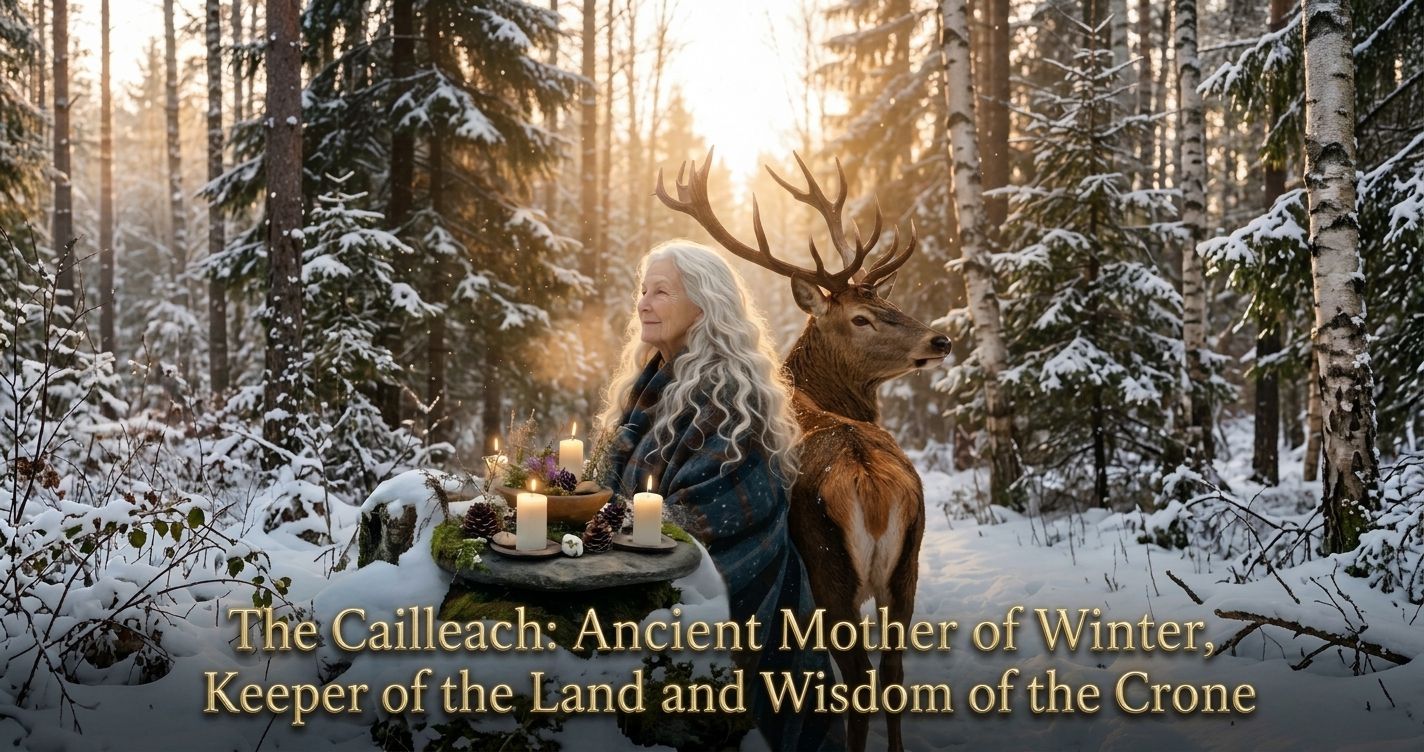
Discover the ancient Celtic spirit of winter, her connection to the changing seasons, the wisdom she offers us and how we can work with her in our own spiritual journeys.
There is a particular kind of magic that belongs to winter. It is found in the stillness of the frozen earth, the whisper of the wind across the hills, the bare branches of ancient trees and the deep silence that settles over the land after snowfall.
It is a season that invites us to slow down, turn inwards and listen to the quieter wisdom of nature. Beneath the sleeping earth, life continues its hidden work, even when the world above appears dormant.
Within Celtic folklore and spiritual tradition, this ancient winter landscape is closely associated with the Cailleach, a powerful and mysterious feminine presence who embodies the wildness of winter, the wisdom of age, the endurance of the natural world and the ancient creative forces of the land.
She is often called the Old Woman, the Divine Hag or the Queen of Winter. Yet these names only begin to describe her.
The Cailleach is not simply a figure who brings cold weather and snow. She is a keeper of ancient wisdom, a shaper of mountains, a guardian of wild places and a reminder that there is profound beauty and purpose in every stage of life.
As we enter the darker half of the year, we can turn towards her for inspiration, reflection and a deeper understanding of our own seasonal and spiritual journeys.
Who is the Cailleach?
The Cailleach is a fascinating figure found throughout Scottish and Irish folklore, with related traditions in other Gaelic-speaking regions. Her name is generally translated as old woman, although her mythological significance reaches far beyond the ordinary meaning of the word.
She appears in many different forms and stories. In Scottish tradition, she is sometimes known as the Cailleach Bheur or Beira, Queen of Winter. In Irish tradition, we find the Cailleach Bhéara, associated with the Beara Peninsula and the ancient landscape of Ireland.
There is no single definitive account of her origins or nature. Instead, her presence has been woven through generations of folklore, place names, seasonal customs and stories passed down through the people who lived close to the land.
In some traditions, she is an ancient giantess who helped shape the mountains and islands. Stones carried in her apron or basket fell to the earth, becoming hills, rocky outcrops and great mountain ranges.
In others, she is the powerful spirit of winter, bringing storms, frost and snow as she moves across the landscape. Her cloak covers the mountains, while her staff or hammer brings the cold and freezes the earth.
She is also associated with the wild creatures of the Highlands, particularly deer, and with the remote mountains, moors and storm-swept coastlines.
What makes the Cailleach particularly interesting is that she is neither simply benevolent nor malevolent. She represents nature in her untamed form: powerful, beautiful, sometimes harsh and always deserving of respect.
She reminds us that nature does not exist solely to provide comfort. There are times when we must learn to adapt, endure and recognise that we are part of something much greater than ourselves.
The Cailleach and the turning of the seasons
One of the most familiar associations of the Cailleach is her connection with winter.
In Scottish seasonal folklore, her reign is often associated with Samhain, when the darker half of the year begins, continuing into the early months of spring.
As the days shorten and the warmth of summer disappears, her presence is felt across the landscape. The trees shed their leaves, the earth becomes harder beneath our feet and the natural world begins its retreat into winter.
We might imagine her walking across the mountains, her cloak sweeping over the hills and her breath carried upon the cold northern winds.
Yet winter is not simply a time of endings. It is a necessary part of the great cycle of renewal. Seeds rest beneath the earth, animals conserve their energy and trees draw their life force inwards. What appears lifeless is simply preparing for another awakening.
The Cailleach teaches us to respect this natural rhythm. In modern spiritual practice, we can look to her as a reminder that we do not need to be constantly growing, achieving or producing. There are times when our souls need rest, reflection and the freedom to simply be.
Her winter is a time for gathering our strength, releasing what has served its purpose and preparing for the next chapter of our lives.
The relationship between the Cailleach and the spring maiden
The Cailleach is sometimes placed in opposition to Bride, or Brigid, the feminine presence associated with spring, fertility, renewal and returning light.
In some Scottish and Irish seasonal traditions, the two are connected through the changing power of the seasons. The Cailleach represents winter’s hold upon the land, while Bride heralds the return of warmth and new life.
At Imbolc, we find an especially interesting point of transition.
The darkness has not completely disappeared, and winter may still have considerable strength, but the first signs of spring are beginning to emerge.
Rather than viewing these two feminine figures as enemies, we can understand them as expressions of the same great natural cycle.
The maiden and the crone are not separate from one another. They represent different expressions of life’s eternal movement.
We need the energy of renewal, but we also need the wisdom of experience. We need the excitement of beginnings, but we also need the understanding that comes from endings.
The Cailleach reminds us that there is no shame in growing older, changing direction or entering a quieter chapter of life.
The spring maiden brings the promise of what may be. The winter crone carries the wisdom of all that has already been.
What the Cailleach represents in our own lives
Although the Cailleach is strongly associated with the winter landscape, her symbolism can be meaningful to us throughout the year.
We can approach her as an archetype of ancient feminine wisdom, connecting with the parts of ourselves that understand endurance, transformation, acceptance and the importance of living in harmony with nature.
Her meaning may be different for each of us, depending upon our experiences, our spiritual development and the season of life we are currently navigating.
The wisdom of the Crone
The Cailleach is often associated with the Crone aspect of the Divine Feminine.
In Goddess spirituality, the maiden, mother and crone are used to represent different expressions of feminine experience. The Crone is associated with wisdom, maturity, discernment, transformation and the acceptance of life’s impermanence.
She reminds us that growing older is not something to fear.
There is a particular strength that comes from having lived, loved, lost, experienced disappointment, overcome challenges and discovered what truly matters.
The Crone does not need to seek approval or prove her worth. She understands herself more deeply and is less concerned with meeting the expectations of others.
Working with the Cailleach can encourage us to recognise our own accumulated wisdom.
Perhaps you are entering a stage of life where old ambitions no longer hold the same importance. Perhaps you are discovering that your spiritual path is changing, or that you have outgrown certain relationships, beliefs or expectations.
The Cailleach invites you to honour the person you have become.
Letting go and embracing endings
Winter teaches us that letting go is a natural part of life.
The trees do not cling to their leaves. They release them, allowing the branches to stand bare against the winter sky.
Likewise, there are times when we must release aspects of our own lives.
This might mean letting go of an old identity, a relationship that has reached its natural conclusion, a limiting belief or an emotional burden that we have carried for far too long.
The Cailleach can be a powerful symbol for this process.
She encourages us to recognise that endings are not necessarily failures. Sometimes they are simply the completion of a cycle.
We can ask ourselves:
- What am I holding onto that no longer supports my growth?
- Which parts of my past am I ready to make peace with?
- What expectations have I outgrown?
- What would become possible if I allowed myself to move forward?
Her wisdom is not about forcing change. It is about recognising when the time has come to stop resisting it.
Strength, resilience and survival
The Cailleach is not a delicate winter spirit. She is powerful, enduring and capable of withstanding the harshest elements. She represents the strength that lies within us when life becomes difficult.
There may be periods when we feel as though we are walking through our own winter. We might be dealing with grief, uncertainty, illness, disappointment or a significant life transition.
During these times, the Cailleach can serve as a reminder that we possess an inner strength that is sometimes revealed only when we need it most.
She encourages us to conserve our energy, protect our boundaries and give ourselves permission to rest.
Resilience does not always mean pushing forward. Sometimes it means knowing when to pause, when to retreat and when to gather our strength before taking another step.
The wisdom of solitude and introspection
The Cailleach belongs to the wild and remote places of the world.
Her landscape is one of mountains, rocky coastlines, ancient forests and lonely moors. These are places where we can experience the immense presence of nature and become more aware of our own inner world.
She represents the value of solitude. In a world filled with constant activity, noise and expectation, we can sometimes lose touch with ourselves.
The Cailleach encourages us to step away from the distractions of everyday life and spend time in quiet contemplation.
This does not mean withdrawing from the world permanently. Rather, it means recognising that we need periods of stillness to understand our thoughts, feelings and spiritual experiences.
Sometimes the answers we seek are found not through doing more, but through becoming quiet enough to listen.
How to work with the Cailleach in your spiritual practice
There are many ways to bring the symbolism and wisdom of the Cailleach into your spiritual practice.
You do not need an elaborate altar or complicated ritual. A sincere intention, an appreciation of the natural world and a willingness to reflect upon her teachings are wonderful places to begin.
Here are some ideas for connecting with her.
Create a winter altar
You might like to create a small altar in your sacred space dedicated to the Cailleach during the darker months of the year.
Choose natural objects that reflect her associations with winter, the ancient landscape and the wild feminine.
Consider including:
- Stones, pebbles or small pieces of slate to represent the mountains and ancient earth.
- White or silver candles to represent frost, snow and winter light.
- Pine cones, bare branches and evergreen foliage.
- Holly, ivy and other plants associated with the enduring life force of winter.
- Clear quartz, smoky quartz or moonstone.
- Images of mountains, deer, ravens or other creatures of the wild.
- A small bowl of water to represent the winter sea, rain and flowing waters.
- You might also include a representation of an elderly woman or a wise Crone figure.
As you arrange your altar, think about what the Cailleach represents to you at this particular time in your life. Your altar does not need to look a certain way. Allow it to become a personal expression of your relationship with winter and the ancient feminine.
Spend time in nature
One of the most meaningful ways to connect with the Cailleach is to spend time in the natural world.
Visit a woodland, walk along a windswept coastline or spend time somewhere you can experience the quieter beauty of the winter landscape.
Notice the bare branches, the textures of the stones, the movement of the clouds and the sound of the wind. Look for signs of life that remain despite the cold.
Evergreen trees, winter berries, birds searching for food and the subtle changes in the earth all remind us that life continues even when it appears to be resting.
As you walk, consider what nature is teaching you.
What needs to rest within your own life? What are you ready to release? Where might you need greater resilience?
Approach the land with respect, taking only photographs and leaving natural habitats undisturbed.
Work with her through meditation
Meditation provides an opportunity to explore the symbolism of the Cailleach and consider what her presence might represent in your own spiritual journey.
Find somewhere quiet, light a candle and allow yourself to become still.
Visualise yourself standing in a vast winter landscape.
Before you are ancient mountains, their peaks covered in snow.
The wind moves gently across the land, and the world is filled with a profound sense of stillness.
In the distance, you notice an elderly woman standing upon a rocky outcrop.
Her hair is silver, her clothing reflects the colours of winter and her presence is strong and commanding.
Rather than approaching with expectations, simply observe her.
Ask yourself what qualities she represents to you.
You might wish to reflect upon these questions:
What wisdom am I ready to receive?
What part of my life is entering a period of transformation?
What do I need to release?
Where do I need to find greater strength?
How can I live more closely in harmony with the natural cycles of the earth?
Remain quietly receptive, allowing your own thoughts, feelings and impressions to emerge.
You may experience something profound, or you may simply enjoy a peaceful period of contemplation. Both are valuable.
Honour the wisdom of your ancestors
The Cailleach is deeply connected with the ancient landscape and the traditions of the people who lived close to the land.
For those of us who feel drawn to Celtic ancestry and Druidry, she offers an opportunity to reflect upon the relationship between our ancestors, the natural world and the wisdom passed down through generations.
Consider exploring the folklore of your ancestral regions.
Learn about the mountains, rivers, forests and sacred places connected with your family heritage. Discover the seasonal customs, stories and traditions that shaped the lives of those who came before you.
You might also create a small space on your altar to honour your ancestors, placing photographs, meaningful objects or symbols of your heritage there.
Remember that ancestral connection is not simply about looking backwards. It is also about considering what wisdom, values and traditions we wish to carry forward.
Practise the art of winter reflection
The Cailleach encourages us to embrace the quieter months as a time of spiritual housekeeping.
You might like to keep a winter journal, recording your thoughts, dreams, reflections and intentions.
Rather than concentrating entirely upon what you wish to achieve, consider what you wish to leave behind.
Write about the lessons you have learned, the experiences that have changed you and the things you now understand differently.
You could also write a letter to yourself, acknowledging how far you have travelled and recognising the strength it has taken to reach this point in your life.
Allow this to be a time of appreciation rather than judgement.
You do not need to have everything figured out. Sometimes it is enough to acknowledge where you are and trust that the next season will arrive in its own time.
The Cailleach and the different seasons of our lives
Perhaps one of the most beautiful ways to understand the Cailleach is to consider how her symbolism relates to the different seasons of our own lives.
We often think of seasonal symbolism in terms of nature, but our lives also move through periods of growth, abundance, change, rest and renewal.
There are times when we feel like spring, full of enthusiasm, curiosity and new possibilities.
There are times when we experience the abundance of summer, enjoying the fruits of our efforts and sharing our gifts with the world.
Autumn brings its own wisdom, inviting us to reflect upon what we have achieved, what we have learned and what we are ready to release.
And then there is winter.
Winter may arrive through age, bereavement, personal transformation, changing circumstances or simply a growing desire for a quieter and more meaningful existence.
It is not necessarily a difficult season, although it can be. It can be a time of extraordinary spiritual growth.
The Cailleach reminds us that we do not have to resist these transitions. We can learn to recognise the gifts that each stage of life brings.
For some, she may represent the wisdom of later life and the freedom of no longer needing to meet everyone else’s expectations.
For others, she may represent the strength required to navigate a challenging period, or the courage to release an identity that no longer feels authentic.
For someone beginning a new spiritual journey, she may represent the importance of looking beyond superficial appearances and developing a deeper understanding of themselves.
And for those who have spent much of their lives caring for others, she may represent the invitation to turn some of that care towards themselves.
Her message is not that we should all become solitary or withdraw from life. Rather, she reminds us that every season has its purpose, and that our worth is not measured by how much we produce or how useful we are to others.
Sometimes our greatest growth takes place beneath the surface.
A winter blessing to the Cailleach
You may wish to use the following words as a simple winter blessing, either at your altar, during meditation or when spending time in nature.
Ancient Mother of the Winter Lands,
Keeper of the mountains, the stones and the wild places,
Wise Cailleach, whose cloak brings frost and whose breath rides upon the northern winds,
I honour the wisdom of the changing seasons.
Teach me to recognise the beauty in stillness,
The strength within surrender,
And the wisdom that comes through living.
Help me release what no longer belongs upon my path.
May I find courage in times of uncertainty,
Peace in moments of solitude,
And understanding in the changing seasons of my life.
As the earth rests beneath your winter mantle,
May I too find the space to rest, reflect and renew.
With gratitude for the ancient wisdom of the land,
And respect for the cycles that connect us all.
Walking with the wisdom of the Old One
The Cailleach invites us to see winter differently.
Rather than viewing it simply as a season to endure until the warmth returns, we can recognise it as an important part of the great cycle of life.
She represents the ancient earth, the wisdom of age, the strength of the wild feminine and the understanding that endings and beginnings are forever intertwined.
Her presence can remind us that there is no need to fear the passing of time or the changing circumstances of our lives. We are not meant to remain forever in one season.
We grow, we change, we experience joy and sorrow, we gather wisdom and, eventually, we learn to release what we once thought we could never live without.
For those walking a Celtic or Druidic spiritual path, the Cailleach offers a beautiful opportunity to deepen our relationship with the natural world and the ancient feminine wisdom woven throughout its cycles.
So, as winter settles across the land, perhaps take a moment to step outside, feel the cold air upon your face and listen to the silence.
Look towards the ancient hills, the bare trees and the wide winter sky.
And remember that beneath the sleeping earth, life is still stirring.
The Cailleach reminds us that even in our quietest seasons, something meaningful is taking place.
For winter is not the absence of life. It is the wisdom of life resting before it begins again.