

The 8 Pillars of Holistic Wellness: Creating Balance in Mind, Body and Spirit
What does it really mean to be well? Is it simply having a healthy body, eating nutritious food and exercising regularly? Or is there something much deeper to our overall sense of health and happiness?
True wellness encompasses far more than our physical condition. It includes how we feel emotionally, the relationships we nurture, the thoughts we explore, the work we undertake, our financial security, our spiritual connection and even the environment in which we live.
This is the foundation of holistic wellness: recognising that every aspect of our lives contributes to our overall wellbeing.
The eight pillars of holistic wellness, also known as the eight dimensions of wellness, offer a helpful way of understanding these different aspects of ourselves. Rather than viewing health as something that exists independently within the body, this approach recognises the interconnected relationship between our physical, emotional, social, spiritual, intellectual, occupational, financial and environmental wellbeing.
Each pillar plays its own important role, yet none exists entirely in isolation. When one area of our lives becomes neglected or unsettled, we may notice the effects rippling into other areas.
By becoming more aware of these eight dimensions, we can begin to make thoughtful choices that support a healthier, happier and more fulfilling way of living.
What Are the 8 Pillars of Holistic Wellness?
The eight pillars of holistic wellness are:
Physical wellness – Caring for your body and physical health.
Emotional wellness – Understanding and nurturing your emotional wellbeing.
Social wellness – Building meaningful relationships and connections.
Spiritual wellness – Finding purpose, meaning and connection.
Intellectual wellness – Encouraging curiosity, learning and creativity.
Occupational wellness – Finding fulfilment and balance in your daily work and responsibilities.
Financial wellness – Developing a healthy relationship with money and financial security.
Environmental wellness – Creating harmonious surroundings and respecting the natural world.
Together, these eight dimensions provide a broader understanding of what it means to live well.
Let’s explore each pillar in more detail, including practical ways to nurture it in everyday life.
Physical Wellness: Nurturing Your Body
Physical wellness is perhaps the dimension most people immediately associate with health. It involves looking after your body, recognising its needs and making choices that support your physical wellbeing.
However, physical wellness isn’t about achieving a particular body shape, following restrictive diets or pushing yourself to exercise beyond your capabilities. It is about developing a respectful and supportive relationship with your body.
Our bodies work incredibly hard for us every day, and they deserve our care and attention.
Physical wellness encompasses several important areas:
- Nutrition: Eating a varied, nourishing diet that provides your body with the nutrients it needs.
- Movement: Finding enjoyable ways to keep your body active, whether through walking, swimming, dancing, yoga or gentle stretching.
- Rest and sleep: Allowing sufficient time for your body to recover, repair and recharge.
- Hydration: Drinking enough water to support normal bodily functions.
- Personal care: Maintaining good hygiene and recognising the importance of everyday self-care.
- Preventive healthcare: Attending appropriate health checks and seeking professional medical advice when needed.
It is also important to listen to your body. There will be times when you have plenty of energy and other occasions when you need to slow down. Learning to recognise these changing needs is an important part of physical wellness.
Ways to nurture your physical wellness:
- Start with small, manageable changes. Take a walk in nature, establish a more consistent bedtime, enjoy a nourishing meal or make time for an activity that makes your body feel good.
- Remember that looking after yourself isn’t selfish. Your physical wellbeing provides an important foundation for enjoying everything else that life has to offer.
Emotional Wellness: Understanding Your Feelings
Emotional wellness is about recognising, understanding and accepting your feelings, while developing healthy ways to navigate life’s challenges.
We all experience a wide range of emotions. Happiness, excitement, sadness, frustration, anxiety, grief and uncertainty are all part of being human.
Emotional wellness doesn’t mean feeling positive all the time or pretending that difficult emotions don’t exist. Instead, it involves developing the awareness and resilience to acknowledge what you are experiencing without allowing every emotion to overwhelm you.
It also means understanding that your feelings deserve attention rather than judgement.
When we continually suppress emotions or ignore our emotional needs, stress and tension can begin to affect other areas of our lives. Learning to process our feelings in healthy ways can help us develop greater self-awareness and emotional resilience.
Some important aspects of emotional wellness include:
- Recognising and expressing your emotions.
- Developing healthy coping strategies for stress.
- Practising self-compassion rather than constant self-criticism.
- Establishing healthy personal boundaries.
- Learning to manage difficult situations.
- Asking for help when you need emotional support.
- Allowing yourself time to rest, reflect and recover.
Ways to nurture your emotional wellness:
- Try keeping a journal where you can express your thoughts and feelings without worrying about how they sound. Meditation, mindfulness, spending time outdoors and creative activities can also provide opportunities to reconnect with yourself.
- You might also find it helpful to practise positive affirmations, particularly when negative thinking begins to affect your confidence or self-esteem.
- Most importantly, remember that you don’t have to be strong every moment of every day. Giving yourself permission to feel, process and heal is an important part of emotional wellbeing.
Social Wellness: The Importance of Connection
Human beings are naturally social creatures. Although we all have different needs when it comes to companionship and interaction, meaningful connections play an important role in our overall wellbeing.
Social wellness is about developing and maintaining healthy relationships with family, friends, partners, colleagues and the wider community.
It isn’t necessarily about having a large social circle or constantly being surrounded by other people. A small number of genuine, supportive relationships can be far more meaningful than numerous superficial connections.
Healthy social relationships provide opportunities to share experiences, offer encouragement, receive support and feel that we belong.
They can also help reduce feelings of loneliness and isolation.
Social wellness includes:
- Developing meaningful friendships.
- Maintaining healthy family relationships.
- Communicating openly and respectfully.
- Listening to and understanding others.
- Giving and receiving emotional support.
- Respecting personal boundaries.
- Becoming involved in your local community.
- Creating connections with people who share your interests and values.
It is equally important to recognise that social wellness includes knowing when to step away from relationships that consistently leave you feeling emotionally drained or unsupported.
Healthy connections should allow you to feel accepted, respected and comfortable being yourself.
Ways to nurture your social wellness:
- Make time to contact someone you care about, arrange a coffee with a friend or become involved in a group that shares your interests.
- You could join a walking group, attend a creative workshop, volunteer for a cause close to your heart or simply spend more quality time with the people who matter to you.
- Remember that meaningful connection isn’t measured by how many people you know. It is about the quality of the relationships you nurture.
Spiritual Wellness: Finding Meaning and Purpose
Spiritual wellness is one of the most personal dimensions of holistic wellbeing. It involves exploring your beliefs, values, sense of purpose and connection with something greater than yourself.
For some people, spirituality is expressed through organised religion and faith. For others, it may involve meditation, nature, personal reflection, energy work, spiritual practices or a sense of connection with the universe.
There is no single correct way to experience spiritual wellness.
At its heart, this pillar encourages us to look beyond the everyday demands of life and consider the deeper questions that help shape who we are.
What gives your life meaning? What values are important to you? What makes you feel connected, inspired and at peace?
Spiritual wellness can help us develop a stronger sense of identity and direction, particularly during periods of change, uncertainty or personal transformation.
It may involve:
- Exploring your personal beliefs and values.
- Developing a sense of purpose.
- Practising meditation and mindfulness.
- Spending time in nature.
- Connecting with your intuition.
- Exploring spiritual or religious traditions.
- Practising gratitude and compassion.
- Developing a sense of connection with the world around you.
For those who follow an earth-based spiritual path, connecting with the natural cycles of the seasons, observing the changing landscape and spending time in nature can become meaningful ways of nurturing spiritual wellbeing.
Equally, moments of stillness, prayer, contemplation or simply watching the sunrise can help us reconnect with what matters most.
Ways to nurture your spiritual wellness:
- Create a little space in your day for quiet reflection. You might enjoy meditation, journalling, prayer, spending time outdoors or exploring a spiritual practice that resonates with you.
- Consider what makes you feel connected to life and how you can bring more of that experience into your everyday routine.
- Spiritual wellness isn’t about following someone else’s beliefs. It is about discovering what gives your own life meaning, depth and purpose.
Intellectual Wellness: Keeping Your Mind Curious
Intellectual wellness is about stimulating your mind, remaining curious and embracing opportunities to learn and grow.
Learning doesn’t stop when we leave school or complete our education. Throughout our lives, we have opportunities to discover new interests, develop skills, challenge our assumptions and explore different ways of thinking.
Keeping our minds engaged can bring a wonderful sense of achievement and personal fulfilment.
Intellectual wellness also involves being open-minded, developing critical thinking skills and allowing ourselves to explore ideas that may be unfamiliar.
It encompasses:
- Reading books and exploring new subjects.
- Learning new skills.
- Developing creative interests.
- Exploring different cultures and perspectives.
- Solving problems and thinking critically.
- Engaging in stimulating conversations.
- Challenging yourself with new experiences.
- Remaining curious about the world around you.
Creativity is another important part of intellectual wellness. Painting, writing, crafting, gardening, music and other creative pursuits allow us to express ourselves while engaging our minds in different ways.
You don’t need to undertake formal education to nurture this pillar. Sometimes the most rewarding learning experiences happen when we simply follow our curiosity.
Ways to nurture your intellectual wellness:
- Read something that interests you, learn a new recipe, explore a historical subject, try a creative hobby or take an online course.
- You could also challenge yourself to learn something completely outside your usual interests.
- Allow yourself to be a beginner. There is something wonderfully liberating about discovering that there is always more to learn.
Occupational Wellness: Finding Fulfilment in What You Do
Occupational wellness concerns the relationship we have with our work, responsibilities and daily activities.
Although the word occupational is often associated with employment and careers, this pillar is much broader. It includes the different roles we undertake throughout our lives, whether as parents, carers, volunteers, students, business owners or homemakers.
It is about finding a sense of purpose, satisfaction and balance in the things that occupy our time.
For some people, occupational wellness comes from having a career they genuinely enjoy. For others, it may involve finding meaning in supporting their family, developing a personal project or contributing to their community.
A fulfilling working life doesn’t necessarily mean having a prestigious job or earning a high salary. It is about feeling that your time, abilities and efforts have value.
Important aspects of occupational wellness include:
- Finding meaning and satisfaction in your work.
- Recognising your strengths and abilities.
- Developing new skills and opportunities.
- Maintaining healthy work-life boundaries.
- Managing workplace stress.
- Feeling appreciated and valued.
- Making time for rest and personal interests.
- Having opportunities for personal growth.
One of the biggest challenges to occupational wellness is allowing work to consume so much of our time and energy that other areas of life become neglected.
A healthy balance is important. Rest, relationships, hobbies and personal wellbeing all deserve space alongside our responsibilities.
Ways to nurture your occupational wellness:
- Reflect on whether your daily activities provide a sense of purpose and satisfaction.
- Consider what you enjoy, what you would like to change and whether there are opportunities to develop your skills or explore something new.
- If you work from home or run your own business, establish boundaries between working hours and personal time.
- Remember that your worth is not determined by your productivity. You are valuable beyond what you achieve or accomplish.
Financial Wellness: Creating Security and Peace of Mind
Money isn’t everything, but financial uncertainty can have a considerable effect on our overall wellbeing.
Financial wellness is about developing a healthy relationship with money, understanding your financial circumstances and making informed decisions that support your present needs and future security.
It doesn’t mean being wealthy or having unlimited resources. Rather, it is about feeling more confident and in control of the financial aspects of your life.
When money becomes a constant source of worry, it can contribute to stress and affect our emotional, physical and social wellbeing.
Developing better financial awareness can help reduce some of this uncertainty and provide a greater sense of stability.
Financial wellness includes:
- Understanding your income and expenditure.
- Creating a realistic household budget.
- Managing debt responsibly.
- Building savings where possible.
- Planning for unexpected expenses.
- Preparing for future financial needs.
- Making informed purchasing decisions.
- Understanding financial commitments and responsibilities.
It is important to remember that everyone’s financial circumstances are different. There is no universal approach that works for every household.
Even small steps towards better financial organisation can make a difference.
Ways to nurture your financial wellness:
- Begin by gaining a clearer understanding of where your money goes each month. Review regular expenses, identify areas where you might be able to save and consider setting realistic financial goals.
- You could create a simple monthly budget, start a small savings fund or seek independent financial guidance if you need help planning for the future.
- Try to avoid comparing your financial circumstances with those of other people. Focus instead on making decisions that are appropriate for your own situation.
- Financial wellness is about developing confidence, awareness and greater peace of mind, one step at a time.
Environmental Wellness: Creating Harmony with Your Surroundings
Environmental wellness recognises that the spaces in which we live, work and spend our time can influence our overall sense of wellbeing.
Our environment includes our homes, workplaces, local communities and the wider natural world.
A clean, safe and comfortable environment can support a greater sense of calm and make everyday life more enjoyable. Equally, spending time in nature can provide opportunities to relax, reflect and reconnect with the world around us.
This pillar also extends beyond our immediate surroundings. It involves recognising our relationship with the planet and considering how our everyday choices affect the natural environment.
Environmental wellness includes:
- Maintaining a clean and comfortable living space.
- Creating a healthy working environment.
- Spending time outdoors.
- Appreciating and respecting nature.
- Reducing unnecessary waste.
- Making environmentally conscious choices.
- Supporting local environmental initiatives.
- Creating spaces that feel peaceful and restorative.
For those who feel spiritually connected to nature, environmental wellness can also have a deeper significance.
Walking through woodland, listening to birdsong, watching the changing seasons or spending time beside the sea can remind us that we are part of something much larger than our immediate everyday lives.
Our connection with the natural world can encourage gratitude, perspective and a greater appreciation for the living environment.
Ways to nurture your environmental wellness:
- Spend a little more time outdoors, bring natural elements into your home or create a peaceful corner where you can relax.
- You might enjoy tending to plants, supporting local wildlife, recycling more thoughtfully or taking part in a community clean-up.
- You don’t need to make dramatic lifestyle changes. Small, conscious choices can help create a healthier relationship with both your immediate surroundings and the wider environment.
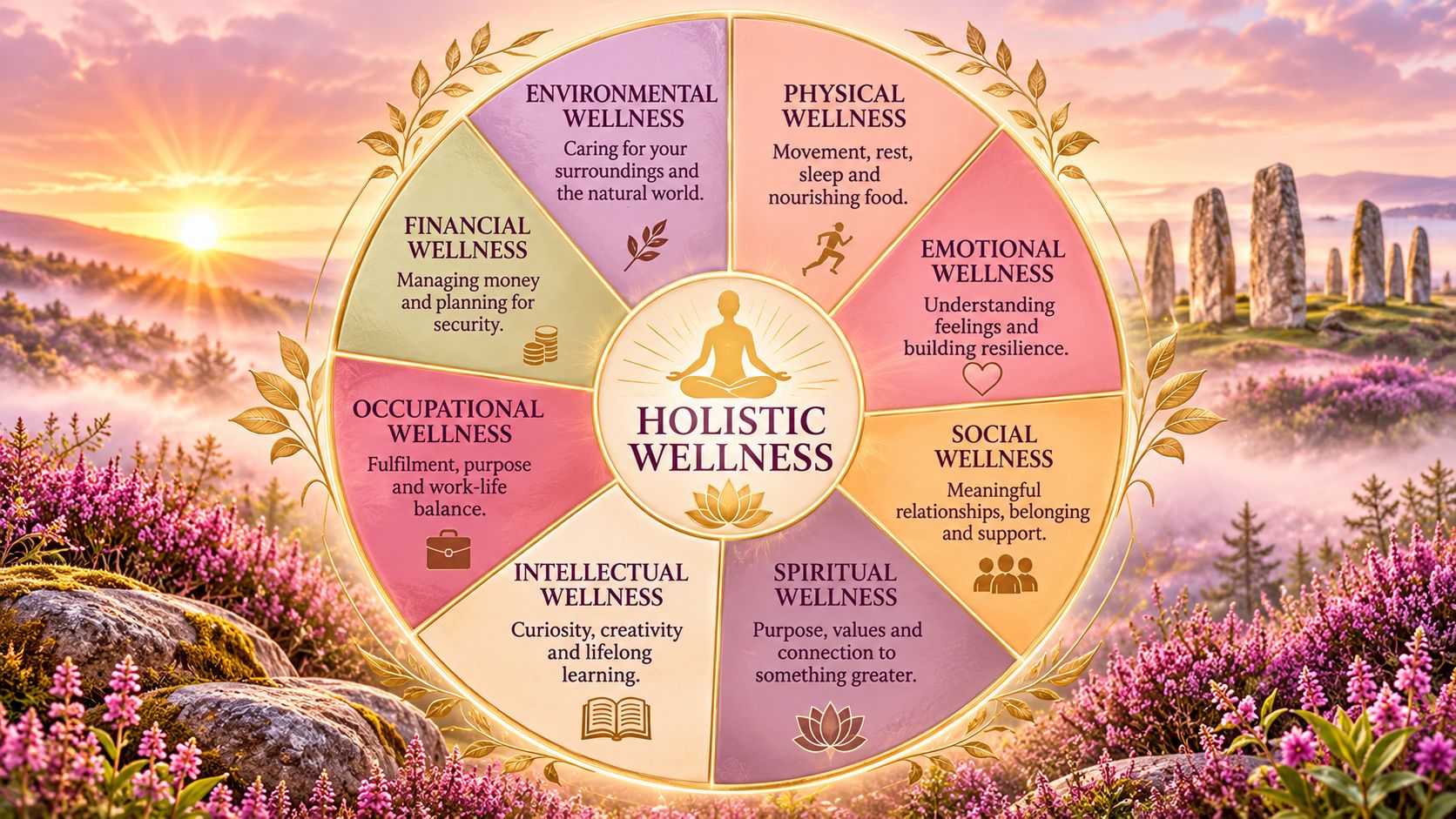
How the 8 Pillars of Holistic Wellness Work Together
One of the most important things to understand about the eight pillars of holistic wellness is that they are interconnected.
Although we explore each dimension separately to understand its importance, they are not independent parts of our lives.
A change in one area can influence several others, sometimes in ways we don’t immediately recognise.
For example, imagine that you are experiencing financial difficulties.
The resulting worry may affect your emotional wellness, making you feel anxious or overwhelmed. This could interfere with your sleep and physical health. You might begin withdrawing from friends and family because you feel embarrassed or preoccupied with your circumstances.
In this situation, one challenge has influenced several dimensions of your wellbeing.
Equally, positive changes can create a ripple effect.
Perhaps you decide to begin walking regularly. This may improve your physical fitness while also providing an opportunity to spend time in nature. The fresh air and movement might lift your mood, while joining a walking group could introduce new social connections.
One small change can nurture several pillars simultaneously.
This is why holistic wellness is about looking at the bigger picture rather than focusing on individual aspects of health in isolation.
Do All Eight Pillars Need to Be Equally Balanced?
No. Holistic wellness isn’t about achieving perfect balance across every dimension at all times.
Life is constantly changing, and our priorities naturally shift depending on our circumstances.
There may be periods when family responsibilities take priority, when we need to concentrate on our careers or when our physical health requires additional attention.
At other times, we might feel drawn towards spiritual exploration, personal development or strengthening our relationships.
The important thing is to recognise when one area of life is consistently being neglected and consider what might help restore a greater sense of harmony.
Think of the eight pillars as a guide rather than a set of rigid rules. They offer a way to reflect on your life, recognise where your needs might not be fully met and identify opportunities for positive change.
How to Bring the 8 Pillars of Wellness into Your Everyday Life
Understanding the eight dimensions is one thing. Putting them into practice is where meaningful personal change can begin.
You don’t need to transform your entire lifestyle overnight. In fact, trying to change everything at once can sometimes create unnecessary pressure.
Instead, begin with awareness.
Take a little time to consider each area of your life and ask yourself whether it currently feels supported, neglected or in need of attention.
Here are some simple ways to get started:
Make time for self-reflection.
Set aside a few quiet moments to consider how you are feeling physically, emotionally and spiritually. Think about what is working well and where you might need additional support.
Identify your priorities.
Rather than trying to improve all eight areas simultaneously, choose one or two that would benefit most from your attention.
Set realistic intentions.
Create small, achievable goals that fit comfortably into your everyday life. A ten-minute walk, a little quiet time or reconnecting with a friend can be meaningful starting points.
Develop supportive routines.
Consider which daily habits help you feel healthier, happier and more grounded. Build these into your routine gradually.
Be kind to yourself.
Personal growth is rarely a straight line. There will be good days and difficult days, periods of progress and times when you need to pause.
Allow yourself the same understanding and compassion you would offer someone you care about.
Review your wellbeing regularly.
Your needs will change as your life evolves. Revisit the eight pillars from time to time and consider whether your priorities have shifted.
Remember, wellness isn’t a destination you eventually reach. It is an ongoing relationship with yourself and the world around you.
A Holistic Approach to Living Well: Mind, Body and Spirit
The eight pillars of holistic wellness remind us that we are more than our physical bodies, our thoughts, our jobs or our relationships.
We are whole individuals, with a complex collection of needs, experiences, emotions, beliefs and aspirations.
When we begin to recognise these different dimensions, we can develop a more compassionate and balanced approach to looking after ourselves.
Sometimes nurturing our wellbeing means moving our bodies and eating nourishing food. At other times, it means allowing ourselves to rest, expressing difficult emotions, spending time with loved ones or reconnecting with our spiritual path.
It might mean learning something new, finding greater satisfaction in our daily activities, taking control of our finances or simply stepping outside and appreciating the beauty of the natural world.
There is no single formula for holistic wellness because each of us has different needs, circumstances and ideas about what makes life meaningful.
The real value lies in becoming more conscious of the choices we make and understanding how the different areas of our lives influence one another.
By giving attention to all eight pillars, we create more opportunities to experience a life that feels fulfilling, connected and harmonious.
And perhaps the most important reminder is this: looking after yourself doesn’t have to involve grand gestures or dramatic changes. Sometimes the smallest acts of self-care, repeated with love and intention, can make the greatest difference.
Your wellbeing is worth nurturing, in every dimension.